Building Europe's First Trillion-Dollar Company

0. intro
When we launched Fund V, we made a commitment - Cherry V would fund Europe's first trillion-dollar company.
More than a marketing line, this is our filter for the ambition we're looking to back.
At the time of publishing, 11 companies hold trillion-dollar valuations.
The reality is that despite Europe's strengths, none are European. While there is much debate about why, or US versus Europe posturing, the reality is that in ten years, that list will be different and every company that reaches trillion-dollar status reinvents itself along the way.
The path from seed stage is impossible to calculate.
The 5-Dimension Framework Cherry Assess Trillion-Dollar Potential
So, when we say we're looking for Europe's first trillion-dollar company - what can we actually identify at seed stage? Not the exact path, but the dimensions that separate founders capable of that level of adaptation and ambition.
And those founders are here. Europe has 40,000 funded startups, a tech workforce that's grown 7x since 2015, and world-class research institutions producing breakthrough technology. At least 92 European-born founders have built US unicorns - the talent exists. What's needed is clarity on what trillion-dollar potential looks like.
After seeing thousands of pitches, scaling companies like Spotify, Zalando, and Uber, and backing 130+ startups including multiple unicorns, we've built a framework for identifying that potential.
This is Cherry's Breakout Check. Five dimensions we use to assess trillion-dollar ambition at seed stage. The self-assessments are inherently subjective - you're evaluating your own company. But that's the point. The questions surface gaps in your thinking before investors do.
1. Problem Selection:
“GDP LEVEL IMPACT”

What it means
The problems that create trillion-dollar companies fundamentally reshape how we live and work. They don't optimise existing systems - they question whether those systems should exist at all.
What we look for
We're drawn to founders who make us question the future, who articulate problems so fundamental that solving them creates entirely new categories or reshapes existing ones.
.svg)
"We want to work with companies that have the ambition to have GDP level impact, to really change the world with the products that they're building."
- FILIP DAMES
PArtner @ Cherry
This means the problem you've chosen affects hundreds of millions of people or represents hundreds of billions in value. It means you can articulate why NOW is the moment this becomes solvable, and crucially, it means you can paint the picture of what your company becomes if everything goes right. What's the headline five years from now? What changes in the world because you succeeded?
the test
Does solving your problem create second-order effects that reshape entire industries?
Take Robeauté, for example. They are building microrobots for brain intervention. The immediate problem is simply better treatment options for neurological diseases.
However, consider the profound second-order effects: brain diseases, including Alzheimer's, strokes, and tumors, affect one in three people globally. Current treatment options are often crude, involving highly invasive surgery or systemic drugs with massive side effects.
If Robeauté succeeds, the impact extends far beyond incrementally improving neurology. They would fundamentally change how medicine approaches the brain. Precision intervention at a microscopic level opens up entire categories of previously untreatable conditions, effectively reshaping not just neurology, but the entire pharmaceutical and medical device industries.
One makes an existing system slightly better. The other makes previously impossible things possible.
When you describe your problem, can you trace that same logic?
.svg)
Take the quiz and find out at the end of this story.
Self-Assessment
2. Market Orientation:
Global Ambition from Day One
What it means
Trillion-dollar companies reshape global markets. But global ambition at seed stage isn't about having customers on six continents. It's about demonstrating you understand how to achieve category dominance wherever your category exists.
Two execution paths
Some products are global from launch. For example, Dash0's observability platform works for developers anywhere - language, borders, and regulations don't constrain it, and Swap Commerce builds cross-border infrastructure that's inherently international. AI can accelerate this: Kiku screens candidates in 100+ languages from day one, dissolving barriers that once required market-by-market localisation.
But AI also commoditises fast - if multilingual support is your only moat, what happens when competitors add it next quarter? AI-native companies need defensibility beyond capabilities that will become table stakes.
Other products require deep specific local proof before expansion. Think regulated markets, physical infrastructure, or businesses local relationships matter. But starting local isn't the same as thinking local. When you pitch us, we need to hear why you're conquering your first market and exactly how that playbook transfers to markets two, three, and four.
Flix is the perfect case study. They started in Germany specifically because of bus deregulation - a regulatory unlock that created their market. But from day one, they articulated why Germany first (regulatory complexity, fragmented market, blueprint potential) and how the playbook would scale, eventually acquiring Greyhound in the US.

-DINIKA MAHTANI
PArtner @ Cherry
Self-Assessment
3. Narrative Precision:
Clarity and Conviction
CLARITY
What it means
At seed stage, your product is incomplete and your metrics are early. Your narrative is the product. Can you articulate why this problem, why you, why now with the kind of clarity that makes investors and early employees bet their careers on an uncertain future?
what gets our attention
We want founders who make us believe the future will look different because they exist. Not through hand-waving or hype, but through clear logic: here's the problem, here's why every existing solution fails fundamentally, here's why now is the moment, and here's why we're the only team that can execute this.
European founders often edit themselves. We're culturally trained to be measured, to qualify claims, to avoid seeming arrogant. But there's a vast difference between arrogance and conviction. The best founders we back are honest about how hard this will be, but unshakeable in their belief that they're going to do it anyway. Make bold claims about the future you are building and defend them with evidence.
Timid pitches = "we could maybe" or "potentially we might." If you're not confident this will change the world, why should we be? We also pause when founders can't explain defensibility beyond "first mover advantage," when they pitch features instead of missions, or when they claim to solve every problem for every customer.
Great companies are precise about where they start and why that's the wedge into something massive.
Self-Assessment
4. Execution Velocity.
Metrics That Force Different Decisions

What it means
Velocity is about setting targets that force you to operate fundamentally differently than competitors. The right metrics make you uncomfortable because they require you to rethink everything - hiring, product priorities, go-to-market strategy.
What we look for
Founders who choose metrics that prove their category thesis. Most early-stage companies track users, revenue, or engagement. Those matter, but they're lagging indicators. We want to see leading indicators that demonstrate you're creating something new.
Take Telli. They track calls handled and CAC like any growing company. But they obsess over conversation quality scores and first-call resolution rates without human handoff. Standard metrics tell them if they're growing. Uncomfortable metrics tell them if they're creating something fundamentally new - whether AI can actually handle complex, emotional customer interactions at a level humans couldn't achieve alone.
That metric forces every decision to ladder back to one question: are we improving the thing that makes us category-defining, or just optimising what makes us a better call centre? Next to tracking the classics that prove you're building a business, track the indicators that demonstrate you're creating something new.
the framework
Users, revenue, expansion
Category-specific milestone
How it changes your decisions
-Christian Meermann
PArtner @ Cherry
Self-Assessment
5. Team Gravity:
Attracting Builders Who Bet Their Careers

What it means
Trillion-dollar companies are built by teams who could work anywhere and chose to work on this problem. At the seed stage, we look for evidence that exceptional operators are betting their careers on your mission.
What we look for
Founder-market fit: Have you lived this problem? Do you have unique insight from lived experience, not just market research? Beyond the founding team, can you attract operators above your current weight class? Are people leaving stable jobs or other startups to join you?
We're drawn to founders who make us question the future, who articulate problems so fundamental that solving them creates entirely new categories or reshapes existing ones.
-DINIKA
Prtner @ Cherry
The best founders create gravity - advisors offer help without being asked, investors reach out before the round opens, early employees recruit their networks. More than charisma, this is about mission clarity and the sense that this team specifically can execute on this problem.
Founding teams with no connection to the problem they're solving.
Inability to articulate why world-class operators would join at seed stage.
Generic answers about "passion" without specific examples of talent attracted.
Self-Assessment
The Cherry Advantage:
What We Provide
Problem Selection
We back the hard problems
We ask every founder: if all the stars align, what could this company become? We're drawn to category-defining problems that make the world materially better. That's why we back companies like Dash0 (next-generation observability), AMBOSS (improving doctor’s clinical decision-making), Robeauté (precision brain intervention), and The Exploration Company (space logistics). The biggest problems create the biggest outcomes, regardless of sector.
Market Orientation
We connect you to the global networks that matter
Our Opportunity Fund allows us to double down on winners at Series B and beyond, providing capital continuity as you scale. We maintain active relationships with key Tier 1 late stage investors throughout your time in our portfolio - when you're ready for Series A+, those aren't cold intros but warm handoffs to investors tracking your progress. Result: 80% of our seed founders graduate to Series A, 4x the industry standard.
Narrative PrecisioN
We help you craft the story that attracts capital and talent
Our partners have pitched at every stage from seed to IPO. We work with founders to refine their equity story, navigate binary market dynamics (AI vs. non-AI, deep tech vs. application layer), and develop narratives that work for both technical and financial audiences. That 80% graduation rate? Narrative precision is a major reason why.
Execution Velocity
We bring operator DNA from companies that achieved global scale
Sophia led Spotify's international expansion. Dinika built Uber's early European markets. Filip and Christian scaled Zalando across borders. When you face the messy reality of scaling - hiring too fast, entering new markets, navigating regulation - we've lived it. We push you to set uncomfortable metrics because we know what's possible when you do.
Team Gravity
We help you recruit the operators who build category leaders
Our LP base includes founders of Supercell, Wolt, and Flix. When you need to hire above your weight class or attract advisors with specific expertise, we make those connections alongside our preeminent Talent team.
Why We Believe It Can Be Done
The math on trillion-dollar companies is changing. Microsoft took 44 years to reach that milestone. Google took 21 years. Meta took 17. Tesla reached it in 12.
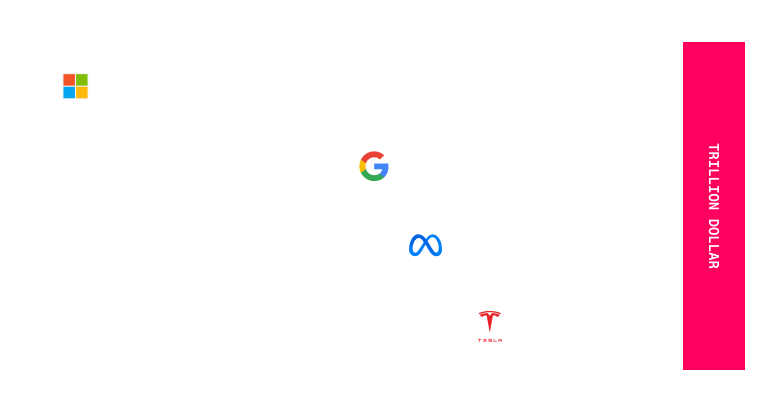
The mathematics of exponential value creation has fundamentally shifted in favor of Europe. The data reveals a dramatic compression in the timeline required to build world-changing companies, and Europe's convergence of three structural forces positions the continent to capture an outsized share of this accelerating opportunity.
The infrastructure moment
European companies are building AI and infrastructure foundations that will power decades of innovation. Backed by increasing historic government and private investment and anchored by advanced photonic processors and energy infrastructure, Europe is positioning itself as a leader in applied AI and the digital industries of the future. These investments are boosting market value and enabling traditional industrial giants to provide essential capabilities in the global race for next-generation compute and intelligence.
Capital efficiency
The convergence of cloud platforms, open-source software, and energy-efficient data centers allows European founders to scale sophisticated products with a fraction of the capital once required. Asset-light business models, previously the preserve of software, are now viable in deep tech, hardware, and biotech, fueled by Europe’s highly skilled talent pool and competitive operating costs.
Global markets from day one
Digital distribution means European founders can serve customers worldwide immediately. The friction of international expansion hasn't disappeared, but it's lower than ever. Companies like Swap Commerce are building infrastructure that reduces it further. Geography matters less. Ambition matters more.
Europe specifically has an advantage at this moment. Deep research institutions producing breakthrough technology. A talent base that's grown 7x since 2015. An ecosystem of operators who've built global companies and are now investing in and advising the next generation.